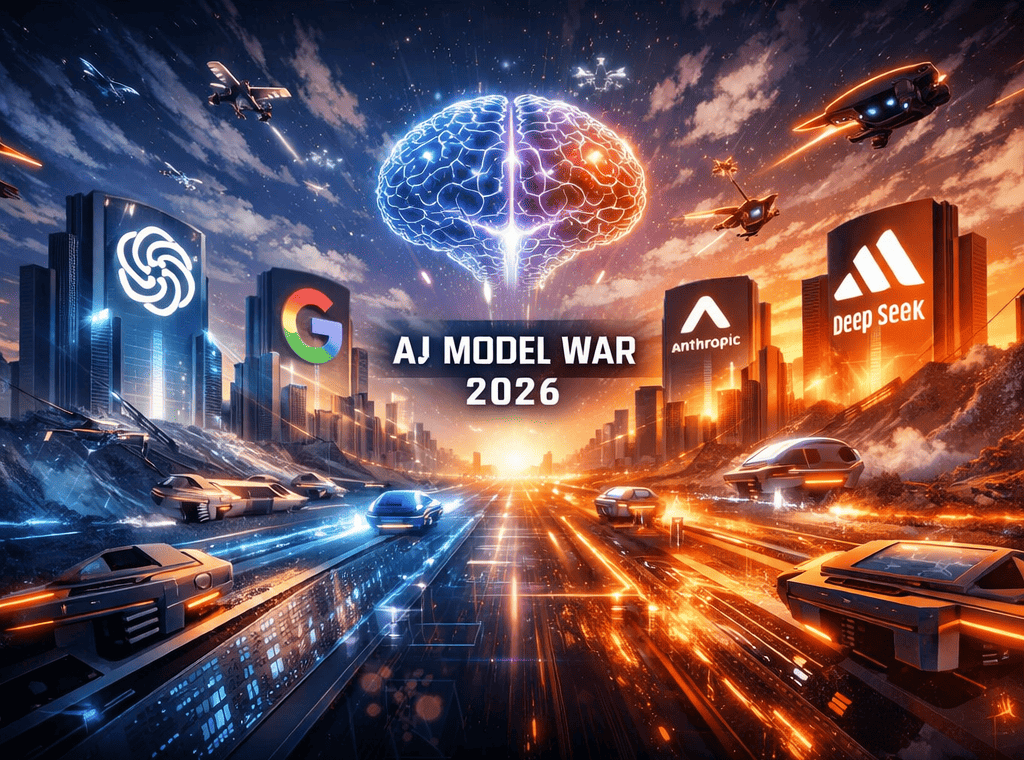
Since the start of 2026, the artificial intelligence sector has been experiencing an unprecedented acceleration. The major players — OpenAI, Anthropic, Google, Mistral, and Asian challengers like DeepSeek — are locked in a frantic race for the best language model. A new release every week, sometimes more. Benchmarks falling one after another. And for users, one question keeps coming up: which tool should I choose today?
This article takes stock of the current landscape, the concrete advances of each model, and — most importantly — what this technological war means for you, whether you’re an entrepreneur, content creator, developer, or simply curious about tech.
1. The Context: Why Is the Battle Intensifying So Much in 2026?
For a long time, OpenAI and ChatGPT dominated the consumer market alone. GPT-4 was the reference point, and all competitors were trying to catch up. In 2026, that paradigm has completely changed.
Three factors explain this simultaneous explosion of model releases:
– Training costs have dropped dramatically, allowing more players to enter the race. permettant à plus d’acteurs d’entrer dans la course.
– Synthetic training data makes it possible to build specialized models much faster.
– Investor pressure pushes each lab to publish regularly to justify sky-high valuations.
The result: as of March 2026, more than 500 language models are available on the market, according to the LLM Stats tracker. The most influential ones are concentrated around five major players.
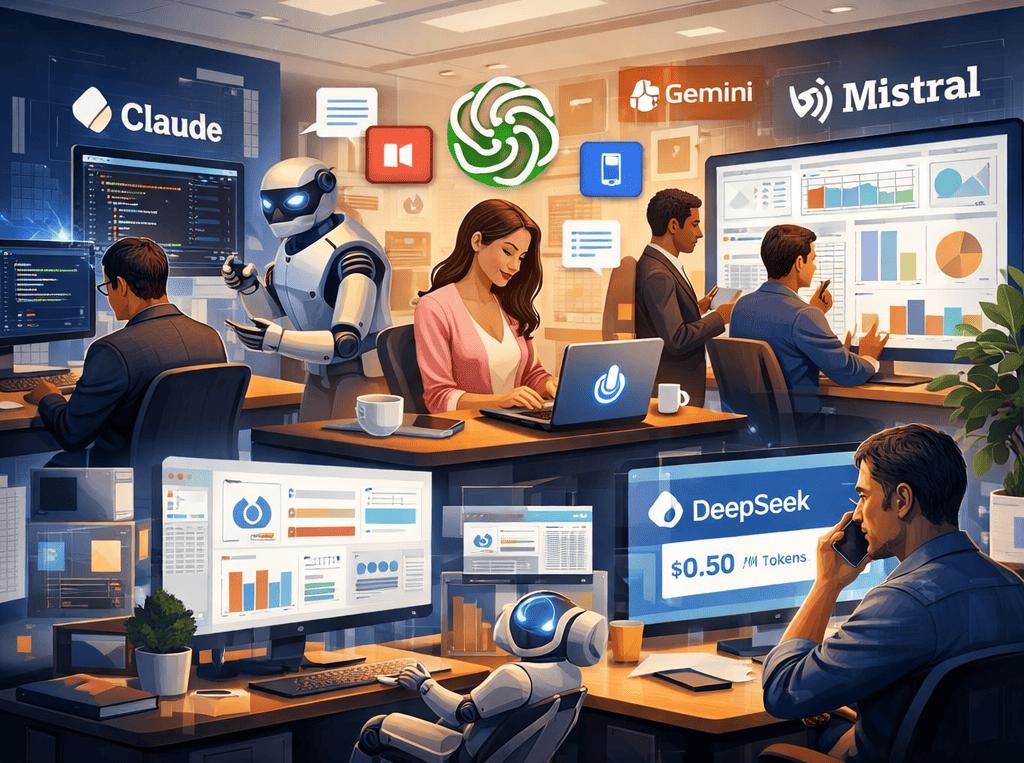
2. The 5 Major Players and Their Latest Advances
OpenAI & GPT-5.2 — The Pioneer Under Pressure
ChatGPT remains the most widely used tool in the world, with more than 700 million active users per week. Yet OpenAI is going through a difficult period. The release of GPT-5 had disappointed part of the community, seen as less revolutionary than expected.
GPT-5.2 came to set the record straight: it shows notable progress on long-form reasoning and advanced technical tasks, including a perfect 100% score on the AIME 2025 (advanced mathematics exam) without external tools. For creative writing and everyday versatility, GPT-5.2 remains the go-to reference for the general public.
 Watch out: The high frequency of model releases at OpenAI complicates standardization for companies automating their workflows via the API.
Anthropic & Claude 4.5 — The Code and Writing Champion
Anthropic clearly strengthened its position in late 2025 with the Claude 4.5 family (Opus, Sonnet, Haiku). On coding tasks, Claude Opus 4.5 has dominated the WebDev Arena since January 2026, with a 74.4% success rate on SWE-Bench — the gold standard for evaluating coding capabilities.
– Claude 4.5 Opus: #1 on WebDev Arena, best for complex code and long-form analysis.
– Claude 4.5 Sonnet: excellent value for money ($3/M tokens), ideal for production use.
– Claude Code: autonomous coding agent capable of working for several hours continuously.
– Claude Cowork: launched in January 2026, lets non-developers automate file and task management.
Google & Gemini 3.1 — The Integration Giant
Google completely revamped its offering in 2026. Goodbye Gemini Advanced, hello AI Plus, AI Pro, and AI Ultra. The flagship model, Gemini 3.1 Pro, has an unmatched context window of 10 million tokens — enough to analyze entire document libraries in a single request.
Its main advantage remains its native integration with Google Workspace: Gmail, Docs, Sheets, Meet. For any organization operating in the Google ecosystem, Gemini has become a natural and frictionless assistant.
Mistral AI — The European Sovereignty Champion
Mistral AI has established itself as the champion of digital sovereignty. With Mistral Large 3, the French startup delivers performance comparable to GPT-4 at roughly 20% of the cost. Its open-source model can be self-hosted on your own infrastructure (OVH, Scaleway) — your data never leaves your environment.
 France Update: France’s DINUM recently deployed a sovereign AI assistant based on Mistral for 30,000 French government agents. Digital sovereignty is no longer an abstract concept.
DeepSeek V4 — The Chinese Challenger Disrupting Pricing
DeepSeek is the disruptor nobody saw coming. Its V4 model delivers GPT-4-level performance at a cost of $0.50 per million tokens — 30 to 60 times cheaper than premium models from OpenAI or Anthropic. For high-volume use cases (customer support, classification, extraction), it completely reshapes the economics.
3. AI Model Comparison Table — 2026
Model | Developer | Strength | Best For | Pricing (API) |
GPT-5.2 | OpenAI | Full multimodal | Daily productivity | ~$15/M tokens |
Claude 4.5 Opus | Anthropic | Code & reasoning | Dev & long analysis | ~$30/M tokens |
Gemini 3.1 Pro | 10M token context | Docs & Workspace | ~$7/M tokens | |
Mistral Large 3 | Mistral AI | GDPR sovereignty | EU enterprises | ~$4/M tokens |
DeepSeek V4 | DeepSeek | Ultra-low cost | Volume & scalability | ~$0.5/M tokens |
Sources: WebDev Arena Jan. 2026 / BDM / Jedha / YoungData — Indicative API pricing, varies by plan.
4. What This War Concretely Changes for You
For Entrepreneurs and Freelancers
The good news: you’ve never had so many options at such accessible prices. The bad news: choosing the right tool has become a genuine strategic decision in its own right.
– For marketing content and social media posts: Claude 4.5 Sonnet or ChatGPT GPT-5.2.
– For automating repetitive admin tasks: Claude Cowork (non-developers) or Claude Code (developers).
– For competitive research and industry monitoring: Perplexity AI or Gemini with its massive context capabilities.
– If you face GDPR constraints and data confidentiality is critical: Mistral via private self-hosting.
For Content Creators
Generative AI is no longer a replacement tool — it’s a collaborator. The dominant trend of 2026 is the shift from isolated prompts to autonomous agents: you describe an objective, and the AI plans and executes a sequence of tasks to achieve it.
For Kay News and tech content pages, this means it’s now possible to delegate monitoring, summarization, and even first-draft scripting to an agent — while keeping full control over tone and editorial angle.
For Developers
The agentic coding war is on. Cursor, Windsurf, GitHub Copilot, Claude Code — seven IDEs are competing for the AI-assisted development market. The trend: agents capable of working in parallel on multiple tasks, without constant human intervention. Claude Opus 4.5 leads this segment in 2026.
5. How to Choose Your AI Model in 2026
Faced with this overwhelming offer, here is the golden rule to remember: there is no universally best model. There are only good choices in context.
– You’re just starting out and want to explore: begin with GPT-5.2 or Claude 4.5 Sonnet via their free interfaces.
- – You’re building a product or API integration: adopt a hybrid strategy — lightweight model for volume, premium model for complex tasks.
- – You have strong GDPR constraints: go with Mistral self-hosted on European infrastructure.
- – You’re looking to reduce costs at scale: DeepSeek V4 or Gemini Flash for high-volume tasks.
- – You’re in the Google ecosystem: activate Gemini in Workspace today — it’s native and frictionless.
 Kay News Recommendation: For the vast majority of entrepreneurs and creators in France, the Claude 4.5 Sonnet + Perplexity AI combination covers 90% of everyday needs at a reasonable cost. For advanced technical use cases, Claude Opus 4.5 remains the reference.
The AI model war is not a niche technology story reserved for engineers. It’s a structural shift that is redefining what individuals and businesses can accomplish, how fast, and at what cost.
In 2026, ignoring generative AI in your business is like ignoring the internet in 2005. The question is no longer whether you should adopt these tools — it’s which ones, and how to integrate them intelligently into your workflow.
At Kay News, we continue to cover these developments every week. Follow us on TikTok so you never miss an update, and let us know in the comments: which AI model do you use in your daily life?